E-Mail: sales@microapproachmed.com
Phone: +86-17722685792
- All
- Product Name
- Product Keyword
- Product Model
- Product Summary
- Product Description
- Multi Field Search

Views: 0 Author: Site Editor Publish Time: 2026-11-13 Origin: Site


For medical device OEMs, sourcing a reliable balloon inflation device is a high-stakes decision where component failure directly impacts patient safety and regulatory standing. You rely on these critical instruments to deliver precise pressures during complex procedures. Inconsistent gauge calibration and micro-leaks during prolonged inflation lead to batch rejections, product recalls, and delayed time-to-market. When devices fail in the field, the fallout extends far beyond initial procurement savings, damaging your brand reputation and inviting intense regulatory scrutiny.
This article provides procurement teams and quality engineers with an evidence-based framework for evaluating supplier testing protocols. We focus specifically on maximizing gauge precision and leak validation to prevent manufacturing delays. You will learn how to assess accuracy standards, understand advanced testing methodologies, and navigate the realities of supplier transitions effectively.
Accuracy non-negotiables: Reliable balloon inflation device gauge accuracy requires strict adherence to ISO 13485 standards and documented calibration traceability.
Testing transparency: Viable OEM partners must provide raw data for every balloon inflation leak test, utilizing advanced pressure decay or volumetric testing methodologies.
Validation realities: Switching suppliers demands rigorous IQ/OQ/PQ re-validation; factor a minimum of 3–6 months for testing and regulatory updates.
Total Cost of Quality (COQ): Upfront unit cost savings are rapidly negated if a supplier's syringe pressure verification processes yield high false-pass rates.
Clinical success heavily depends on precise atmospheric (ATM) pressure delivery. In procedures like coronary angioplasty, physicians inflate balloon catheters to dilate narrowed blood vessels. Even slight pressure variations (+/- ATM deviations) dictate whether a stent deploys correctly or a vessel suffers unintended trauma. Similarly, kyphoplasty interventions require highly controlled balloon expansion to restore vertebral height safely. If a device gauge indicates 12 ATM while the actual output is 15 ATM, you risk catastrophic balloon rupture or tissue dissection. Maintaining extreme precision eliminates these clinical risks and ensures optimal patient outcomes.
Regulatory bodies continue intensifying their scrutiny of pressure delivery systems. The FDA and the European Medical Device Regulation (MDR) demand impeccable gauge calibration records during facility audits. If your supplier fails to maintain unbroken calibration traceability, your final assembly faces immediate compliance risks. The cost of non-compliance surfaces brutally during post-market surveillance. Regulatory agencies often mandate costly field corrections or full-scale product recalls when surveillance detects repeated pressure inaccuracies.
Continuous monitoring during the manufacturing cycle prevents unseen mechanical drift. Component fatigue can alter the internal friction of syringe plungers, causing fluid delivery parameters to shift over thousands of cycles. Implementing robust syringe pressure verification protocols guarantees mechanical forces applied to the handle translate perfectly into fluid pressure. Without frequent verification, mechanical drift remains undetected until the final quality control checks, resulting in massive batch scrap rates and severe financial losses.
Selecting the right pressure measurement technology defines the reliability of your finished medical product. Procurement teams must carefully weigh the clinical application against the technological capabilities of different gauge formats.
Analog gauges offer historical reliability and lower production costs. They operate without batteries, making them highly dependable for rapid deployment scenarios. However, analog dials remain susceptible to parallax errors—where the user's viewing angle distorts the perceived reading. Furthermore, internal bourdon tubes face mechanical fatigue after repeated high-pressure cycles.
Digital gauges provide superior resolution and crisp numerical readouts. They drastically reduce human reading errors in high-stress surgical environments. A common procurement mistake involves assuming all digital units automatically outshine analog counterparts. While digital precision is excellent, these gauges require rigorous battery life validation. You must also evaluate electronic component sourcing stability, as global microchip shortages can halt your entire assembly line.
Analog vs. Digital Pressure Gauge Comparison
Gauge Type | Primary Advantages | Common Vulnerabilities | Best Fit Scenarios |
|---|---|---|---|
Analog | Cost-effective, zero battery dependence, highly durable in harsh transport conditions. | Parallax viewing errors, mechanical spring fatigue, lower display resolution. | Standard PCI procedures, single-use disposable kits, budget-conscious markets. |
Digital | High accuracy, illuminated displays, eliminates viewing angle errors. | Requires battery validation, susceptible to electronic component shortages, higher cost. | Complex structural heart procedures, high-pressure inflations (30+ ATM). |
Every chosen inflation device pressure gauge sits within a broader mechanical ecosystem. Tolerance stacking occurs when minor dimensional variations in the gauge, syringe body, and high-pressure stopcock combine to create significant system errors. Even a perfectly calibrated gauge will deliver inaccurate systemic readings if the connected polycarbonate syringe barrel expands under 30 ATM of pressure. You must evaluate the entire assembly as a cohesive unit rather than isolating individual components.
Supplier calibration standards form the foundation of measurement truth. Look for partners utilizing master gauges traceable to the National Institute of Standards and Technology (NIST) or equivalent regional bodies. Request proof showcasing master gauge recalibration schedules. If a supplier uses master equipment running past its calibration due date, every device they ship carries inherited inaccuracies.
Micro-leaks destroy clinical confidence. Even a microscopic seal failure compromises balloon expansion, putting patients in jeopardy. Understanding distinct leak testing methodologies allows you to hold suppliers accountable.
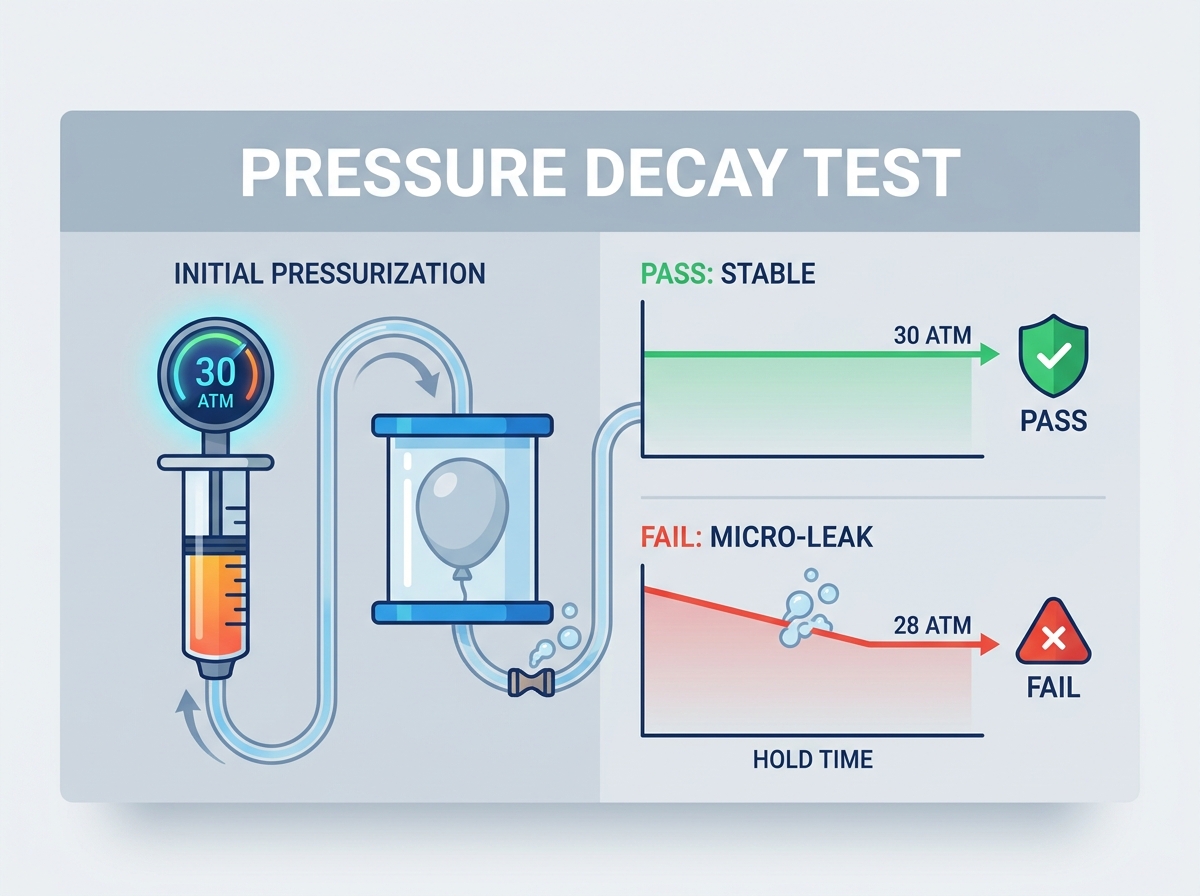
Pressure decay testing remains the industry standard for bulk manufacturing. Technicians pressurize the device to its maximum ATM rating, isolate the system, and measure any pressure drop over a specified timeframe. If the pressure falls beyond a strict threshold, the unit fails. Volumetric leak testing takes a different approach. It detects micro-leaks by measuring actual fluid displacement. This methodology proves crucial for high-pressure balloon catheters requiring absolute fluid retention to maintain specific dilation diameters.
A rigorous balloon inflation leak test protocol begins before the supplier ships anything to your facility. Factory Acceptance Testing (FAT) serves as your primary defense against substandard batches. When reviewing FAT documentation, OEMs should demand clear definitions of several critical parameters:
Target hold times: Ensure the device maintains maximum pressure for at least the duration of a typical complex surgical procedure.
Acceptable leak rates: Define maximum allowable fluid loss in cubic centimeters per minute (cc/min).
Burst testing baselines: Identify the exact atmospheric pressure causing catastrophic structural failure to calculate appropriate safety margins.
Environmental variables: Verify testing occurs at clinically relevant temperatures, not just ambient factory conditions.
Suppliers utilizing automated leak test instrumentation should rank highest on your shortlist. Manual testing relies heavily on operator subjectivity, inviting inconsistencies. Automated systems apply exact pressures, time the test precisely, and generate unalterable digital pass/fail logs. Removing human interpretation from quality control drastically reduces the risk of defective units entering your supply chain.
Past performance serves as the most reliable indicator of future quality. Ask potential partners for historical data on first-pass yield rates, specifically focusing on leak failures. A supplier boasting a 99% overall yield rate might still experience a 10% failure rate at the high-pressure leak testing station. High scrap rates at the leak test phase indicate underlying issues molding tolerances or seal assembly processes. These inefficiencies inevitably cause sudden shipment delays when the supplier struggles to meet your volume requirements.
Medical instruments interact directly with patient fluids and sensitive tissues. Procurement teams must verify material compliance rigorously. Demand documentation proving all polycarbonates, lubricants, and O-rings meet ISO 10993 biocompatibility standards. Durability presents an equally critical hurdle. The selected polymers must withstand specified atmospheres—often exceeding 30 ATM—without crazing, cracking, or yielding. We frequently see OEMs face sudden field failures because they approved a cheaper polycarbonate blend incapable of surviving prolonged stress loads.
When field complaints arise, rapid root cause analysis saves millions in recall expenses. Your supplier must demonstrate an unbreakable audit trail. You need the ability to trace individual lot numbers back to specific gauge calibration dates, raw material batches, and the exact leak test operators on shift. Digital quality management systems compliant with 21 CFR Part 11 offer the highest level of security. If a supplier still relies on paper binders to track calibration certificates, consider them a high-risk liability.
Off-the-shelf solutions rarely fit complex proprietary procedural kits perfectly. Assess the supplier’s engineering capability to modify their standard balloon inflation device designs. Physicians often request specific handle ergonomics, luminescent dials for darkened catheterization labs, or rapid-release mechanisms for instant pressure dumping. However, these customizations must never compromise the established pressure envelope. Excellent partners provide rapid prototyping while simultaneously simulating how ergonomic changes impact internal fluid dynamics.
A successful product launch quickly strains unprepared supply chains. Evaluate the supplier’s controlled environment infrastructure. Do they operate certified ISO Class 7 or Class 8 cleanrooms? More importantly, analyze their quality control bottlenecks. A supplier might possess the injection molding capacity to produce ten thousand units weekly, but if they only own two automated leak testing machines, QC becomes a massive bottleneck. Ensure their testing infrastructure scales symmetrically with their manufacturing output.
Transitioning to a new contract manufacturer introduces substantial regulatory and operational friction. Maintaining optimal balloon inflation device gauge accuracy during a supplier switch requires meticulous planning. Procurement leaders often underestimate re-validation timelines. Onboarding a new device triggers mandatory Design Verification (DV) and Process Validation protocols. Installation Qualification (IQ) verifies equipment setup, Operational Qualification (OQ) tests manufacturing limits, and Performance Qualification (PQ) ensures long-term consistency. You must allocate a minimum of 3 to 6 months to complete these validations and update your regulatory filings accordingly.
Hidden financial burdens frequently disrupt supplier transitions. Tooling and transfer costs rarely fit neatly into initial budget proposals. If your incumbent supplier owns the custom injection molds or proprietary testing fixtures, you face heavy capital expenditures reproducing them. Additionally, calibrating new testing fixtures to match your legacy performance criteria requires extensive engineering hours.
Supply chain redundancy serves as your ultimate safety net. A tier-one supplier is only as resilient as their weakest sub-tier vendor. Evaluate their secondary sourcing strategies for critical sub-components. If your primary partner buys raw pressure gauges or specialized O-rings from a single regional source, a localized disruption will halt your production globally. Robust suppliers maintain qualified backup vendors for every critical component, insulating your operations from unpredictable global shocks.
Sourcing a balloon inflation device is fundamentally an exercise in strict risk management. Your operational success depends entirely on the supplier's commitment to verifiable gauge accuracy and stringent leak testing protocols. Overlooking manufacturing yields, tolerance stacking, or validation timelines inevitably triggers catastrophic field failures and costly regulatory interventions.
To move forward safely, shortlist two to three suppliers based on the strategic criteria outlined in this checklist. Request their standard Factory Acceptance Testing protocols immediately. Finally, secure a sample batch from each candidate to conduct rigorous internal functional testing and independent physical auditing. Securing empirical data now prevents devastating compliance emergencies later.
A: The acceptable accuracy typically ranges between +/- 3% to 5% of the gauge's full scale. The exact tolerance depends entirely on the maximum ATM rating and the specific clinical application. High-pressure balloon dilations require tighter tolerances to prevent vascular damage, whereas low-pressure structural deployments might safely tolerate slightly broader percentage deviations.
A: Units are typically pressurized to their maximum rated ATM and held securely for a specified duration. Automated systems monitor the assembly via pressure decay sensors or volumetric displacement tools. This ensures no pressure loss occurs across internal seals, polycarbonate barrels, or gauge threading, confirming absolute structural integrity.
A: It ensures the mechanical force applied to the syringe plunger translates accurately and consistently to fluid pressure. Repeated high-pressure cycles cause mechanical drift and friction changes. Continuous verification identifies these deviations early, preventing catastrophic balloon bursts or dangerous under-deployment during sensitive medical procedures.
A: Most high-tier suppliers provide lot-level calibration traceability as a standard practice. This covers the entire manufacturing batch based on master gauge data. However, individual unit certification can usually be negotiated for custom assemblies or highly specialized digital devices requiring extreme, documented precision.
