E-Mail: sales@microapproachmed.com
Phone: +86-17722685792
- All
- Product Name
- Product Keyword
- Product Model
- Product Summary
- Product Description
- Multi Field Search

Views: 0 Author: Site Editor Publish Time: 2026-11-23 Origin: Site


Catheter manufacturing carries incredibly high stakes for both patients and medical device companies. Joint failures at the hub or shaft during clinical procedures invite catastrophic patient risks. If a bonded component detaches inside a patient's vascular system, emergency surgical retrieval becomes immediately necessary. These failures trigger costly market recalls. They also guarantee swift FDA 510(k) submission rejections. Engineering teams constantly battle a core design tension during device development. They must preserve extreme flexibility using PEBA-based materials to navigate tortuous anatomy. Simultaneously, they require robust structural rigidity at critical junction points. Striking this balance demands flawless joint integrity.
This article provides R&D and Quality Engineers an actionable evaluation framework. We directly compare mechanical pull tests against pressure testing. You will discover how to select optimal bonding techniques for your specific device. We also outline rigorous validation methodologies. By mastering these testing protocols, you can secure regulatory clearance and ensure absolute patient safety.
Catheter bond strength testing and leak testing are not interchangeable; they serve complementary roles in proving structural durability and hermeticity for regulatory bodies.
Catheter hub bond strength requires specialized evaluation due to the transition from rigid polymers to highly flexible shaft materials, often introducing peak stress concentrations.
The choice between UV adhesive bonding and catheter laser welding significantly alters testing parameters, capital expenditure, and long-term production scalability.
Rigorous catheter weld validation against ISO 10555 standards is non-negotiable for proving substantial equivalence in regulatory submissions.
Trusting a single testing methodology creates a dangerous illusion of security. Many product development teams rely solely on mechanical pull testing. They mistakenly assume high tensile strength guarantees complete joint integrity. This fundamental oversight compromises quality control programs. Mechanical durability does not guarantee a hermetic seal. Quality engineers must look at both performance metrics. Implementing isolated tests leaves your medical device vulnerable to clinical failure. Regulatory bodies demand comprehensive proof of both structural integrity and fluid containment.
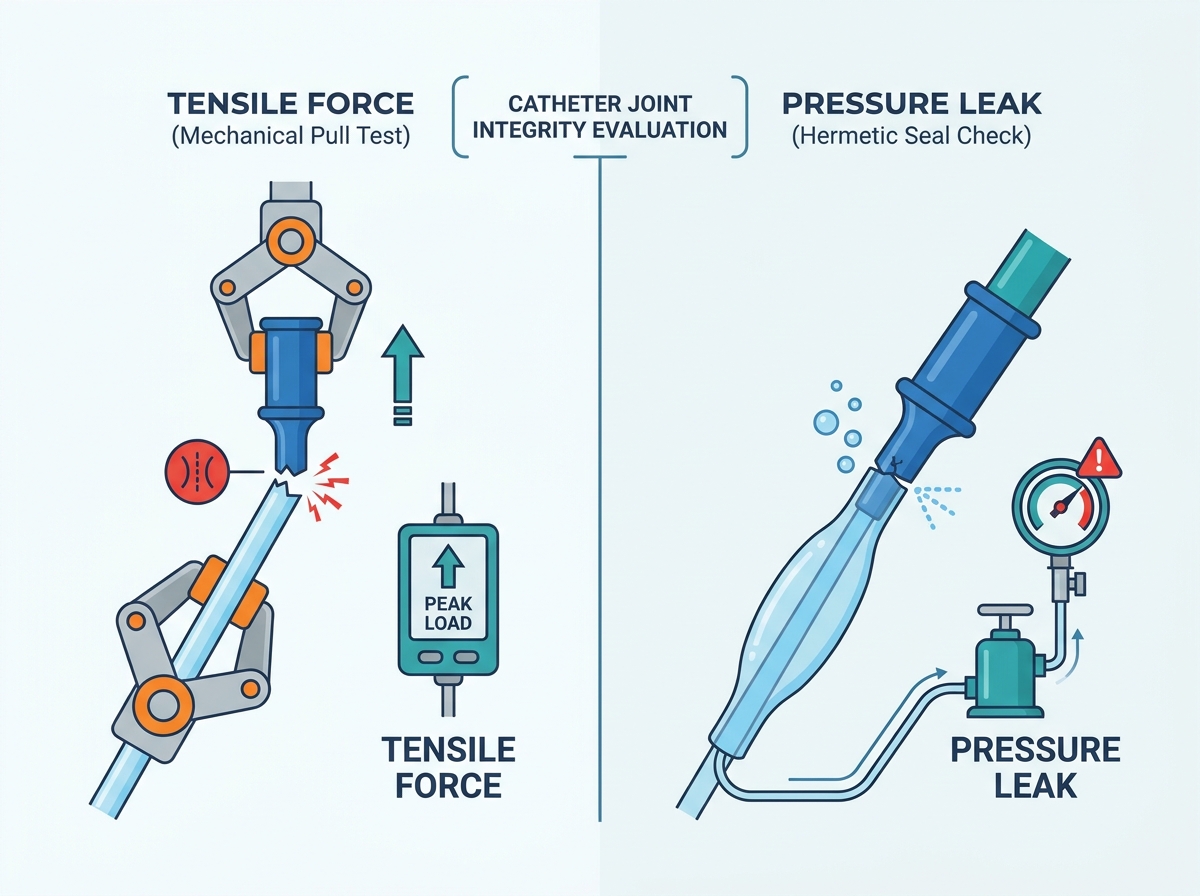
Pull testing measures the absolute maximum mechanical load a joint handles. It shows exactly how much force an assembly withstands before separation. It also reveals the specific moment structural failure occurs. This test is essential for simulating real-world physiological forces. Physicians frequently encounter high withdrawal resistance during tortuous vessel navigation. A proper tensile evaluation identifies specific failure mechanisms.
You can clearly see whether the polymer material yielded first or if adhesive failure happened. Measuring catheter bond strength testing provides the fundamental mechanical baseline. Engineers use highly sensitive universal testing machines (UTMs) to generate precise stress-strain curves. These curves inform critical design adjustments.
Next, we must evaluate the hermetic seal of the assembly. Pressure and burst testing serve this exact purpose. We apply positive or negative air and hydrostatic pressure to the catheter system. A tensile test often misses dangerous micro-fissures. Mechanical pulling cannot detect microscopic pinholes or incomplete circumferential welds.
A validated medical catheter leak test finds these hidden defects easily. Pressure testing confirms fluids will never escape into the patient's bloodstream. Techniques like pressure decay measurement detect pressure drops over time. Even the smallest leak registers on the equipment. This ensures safe delivery of contrast media or therapeutics.
Quality teams require a unified evaluation framework. Baseline bond strength data directly informs safe burst pressure limits. The joint must not only hold together physically. It must maintain total fluid integrity under peak clinical stress. Using both testing methods proves mechanical continuity alongside hermetic safety.
Evaluation Synergy Chart
Testing Phase | Primary Objective | Clinical Relevance | Detected Defects |
|---|---|---|---|
Tensile Testing | Determine max separation load | Withdrawal resistance in vessels | Adhesive failure, material yield |
Leak Testing | Verify hermetic seal integrity | Safe contrast/fluid delivery | Micro-fissures, pinholes, incomplete welds |
Synergistic Evaluation | Correlate strength to burst limit | Overall procedural safety | Combined structural and fluid compromises |
The hub-to-shaft connection presents unique mechanical hurdles. Engineers must join a highly rigid hub to an extremely soft shaft. Hub components typically utilize stiff polymers like polycarbonate or nylon. Conversely, shafts require highly flexible materials like PEBAX or polyurethane. This drastic durometer transition creates a highly vulnerable junction.
The interface between hard and soft plastics resists uniform energy distribution. When you apply stress, the differing material properties fight one another. Creating a durable bond across this gradient demands precise engineering. Poor adhesion here represents a major source of field complaints.
Bending and torsional fatigue disproportionately attack the hub joint. Physicians often twist the catheter during difficult insertions. This torque travels rapidly down the shaft. The rigid hub naturally refuses to bend or rotate. Therefore, all rotational stress concentrates exactly at the bond line. This creates a mechanical hinge effect.
You must engineer specific strain reliefs to mitigate localized fatigue. Incorporating tapered boots helps distribute mechanical loads safely. A gradual stiffness transition protects the critical bond line. Without strain relief, cyclical fatigue causes premature joint separation.
Setting acceptable tensile load baselines requires deep clinical context. You cannot apply arbitrary force values. Cardiovascular catheters endure vastly different forces compared to delicate neurovascular devices. You must establish distinct parameters for catheter hub bond strength based entirely on intended use.
During mechanical testing, you must analyze exact failure modes carefully. Ask yourself specific diagnostic questions:
Did the polymer substrate snap before the bond broke?
Did the joint simply separate at the adhesive interface?
Did the shaft elongate excessively before yielding?
Substrate failure means your bond is stronger than the tubing itself. This is generally the desired outcome. Joint separation directly indicates a flawed bonding process. Engineers use these criteria to optimize manufacturing parameters continually.
Engineers primarily use two distinct methods for creating hub and shaft joints. You must choose between UV curable adhesives and laser energy. Each bonding method deeply impacts subsequent integrity testing. Let us compare these dominant approaches to inform your manufacturing strategy.
Many device manufacturers initiate production using UV adhesives.
Pros:
Requires much lower initial capital expenditure.
Delivers broad compatibility across completely dissimilar materials.
Offers a relatively simple process setup for early prototyping phases.
Cons:
Faces severe curing depth limitations for opaque or colored materials.
Carries inherent biocompatibility risks stemming from uncured liquid resin.
Requires aggressive environmental controls concerning humidity and ambient light.
Advanced, high-volume manufacturing increasingly favors laser energy delivery.
Pros:
Creates a completely seamless, homogeneous polymer matrix.
Eliminates third-party adhesive risks and biocompatibility concerns entirely.
Provides highly repeatable results that are easily automatable for scale.
Cons:
Demands significantly higher initial equipment investments.
Requires highly precise tooling and exacting component alignment.
Faces limitations dictated by material absorption rates and visual transparency.
You must select the process based heavily on material properties. Consider your production scalability requirements. PEBA materials carry high thermal degradation risks. Chemical adhesives sometimes fail to grip their low-surface-energy profiles. By comparison, utilizing precision catheter laser welding allows localized, controlled energy delivery. This protects the delicate PEBA polymer chain while ensuring a fusion bond.
Technology Selection Decision Matrix
Evaluation Metric | UV Adhesive Bonding | Laser Welding |
|---|---|---|
Material Compatibility | Excellent for dissimilar plastics | Best for similar/compatible polymers |
Production Throughput | Moderate (curing time required) | Very High (instant fusion) |
Joint Cleanliness | Risk of flash or uncured resin | Extremely clean, no additives |
Initial Setup Complexity | Low to Moderate | High (requires precise fixturing) |
Joint integrity forms the absolute backbone of regulatory security. FDA 510(k) clearances require concrete proof of substantial equivalence. EU MDR guidelines demand rigorous clinical safety evidence. You cannot simply claim a catheter joint is strong. You must prove it mathematically using validated test methods.
Navigate directly to the ISO 10555-1 testing guidelines. This international standard strictly governs intravascular catheters. Annex B specifically addresses the determination of peak tensile force. The standard dictates exact pulling speeds, conditioning environments, and grip distances. Following these codified rules provides universally accepted testing metrics. Deviating from ISO methodology invites immediate regulatory scrutiny.
Process validation remains absolutely critical for medical manufacturing. Proper catheter weld validation follows a strict three-phase execution framework.
Installation Qualification (IQ): You must verify the laser or UV equipment is installed correctly. Document all utility connections and calibration statuses.
Operational Qualification (OQ): Ensure the equipment performs predictably within specified upper and lower control limits. Establish your optimal process window using Design of Experiments (DOE). Test the extreme edges of your parameter limits.
Performance Qualification (PQ): Prove the established process yields statistically significant passing rates continuously. You must pass both bond strength and leak tests repeatedly. Perform these final evaluations under simulated clinical environments. In vitro bench testing effectively mimics actual physiological conditions.
Regulatory audits always hinge on verifiable evidence. Keep raw data meticulously traceable to specific production batches. Document every observed failure mode thoroughly. Explain the root causes of any anomalous test results. Transparent, evidence-oriented documentation builds massive trust with regulatory reviewers. It transforms a subjective quality claim into an undeniable scientific fact.
Setting up an in-house testing laboratory introduces immediate implementation risks. One remarkably common pitfall involves improper grip selection. Incorrect pneumatic grips easily crush the delicate catheter shaft. Shaft crushing causes premature failure during routine tensile tests. These false negatives waste valuable time. They also force engineers to scrap perfectly good components unnecessarily.
Choose your universal testing machines carefully. Look specifically for systems designed for low-force, high-precision medical applications. Ensure the load cells match your expected peak forces accurately. A 500-newton load cell struggles to measure a 5-newton break force accurately.
For automated leak testers, focus intently on decay measurement sensitivity. The system must detect microscopic pressure drops reliably. Transducer resolution matters deeply. High-resolution equipment catches the slow leaks standard gauges miss entirely.
We strongly recommend adopting a phased approach to equipment investment. Start by utilizing specialized third-party testing services. This helps tremendously during early prototyping and baseline establishment. External labs validate your initial assumptions quickly. Once your product design stabilizes, transition to validated in-house equipment. This logic secures scaled production efficiency.
Catheter joint integrity remains a multifactorial engineering challenge. Success requires intense focus and precise methodology. You must balance optimized bonding methods like laser welding against UV adhesive capabilities. You also need dual-pronged validation strategies to ensure absolute safety. Pair rigorous mechanical tensile testing with highly sensitive pressure leak testing.
We encourage R&D and QA teams to audit their current testing protocols immediately. Compare your existing laboratory methods against strict ISO 10555 standards. Consult with a specialized testing or manufacturing partner today. Proactively evaluating your hub and shaft joint validation processes prevents tomorrow's clinical failures and regulatory delays. Take action now to strengthen your quality control framework.
A: There is no single universal number. Acceptable limits are dictated by ISO 10555 based on the outer diameter of the catheter and the specific clinical indication (e.g., neurovascular vs. cardiovascular). Larger French sizes generally require higher peak tensile thresholds to prove safety.
A: Yes. An adhesive or weld may hold mechanical tension flawlessly. However, it might contain microscopic channels or uneven curing. These hidden defects allow fluid or air escape under working pressure. Both tests are mandatory for complete validation.
A: Laser welding provides localized, highly controlled energy delivery. This energy melts the PEBA material safely. It creates a unified, seamless bond without causing widespread thermal degradation. It also avoids chemical adhesives, which frequently struggle to adhere well to PEBA's unique surface energy.
