E-Mail: sales@microapproachmed.com
Phone: +86-17722685792
- All
- Product Name
- Product Keyword
- Product Model
- Product Summary
- Product Description
- Multi Field Search

Views: 0 Author: Site Editor Publish Time: 2026-10-20 Origin: Site


Radiopaque marker bands are essential for the fluoroscopic navigation of cardiovascular and neurovascular catheters, but their integration presents one of the highest-risk failure points in device assembly. Catheter engineers must achieve a delicate mechanical balance: securing the metal band with sufficient retention force to prevent dislodgement in tortuous anatomy, while maintaining an ultra-low outer diameter (OD) profile and preventing the collapse of the inner diameter (ID) lumen. Achieving this triad of requirements—retention, profile, and lumen integrity—requires precise mechanical compression. This guide evaluates how to select a marker band swager and optimize your assembly process to meet strict regulatory and performance standards.
The Engineering Triad: Successful swaging requires balancing radial compression forces to maximize band retention without inducing polymer flash or crushing the internal guidewire lumen.
Equipment Precision: Modern marker band swager systems must offer micro-level control over die closure, dwell time, and force to ensure high Cpk (process capability) in high-volume production.
Tooling Specificity & Maintenance: Die design must be custom-matched to the specific radiopaque material (e.g., Platinum/Iridium, Gold) and the underlying thermoplastic substrate, requiring strict calibration and maintenance schedules.
Strategic Sourcing: For highly complex micro-catheters, balancing the CapEx of advanced catheter manufacturing equipment against the specialized expertise of catheter OEM services is a critical scale-up decision.
Engineers must define three non-negotiable outcomes for the swaging process that mechanically conflict with one another. High retention force requires aggressive radial compression. This aggressive compression risks collapsing the internal lumen and creating polymer flash on the outer diameter. A flawless outer profile demands minimal material displacement, which often results in poor band retention. Protecting the inner lumen requires internal support that limits how much the polymer can compress. Balancing these three variables dictates the success of the entire assembly operation on the manufacturing floor.
Embedding metal into a polymer substrate requires precise force application. The metal band must displace the underlying polymer slightly to create a mechanical interlock. This interlocking occurs when the polymer flows into the micro-texture on the inner surface of the marker band, providing the primary resistance against axial movement. Engineers calculate the exact compression ratio needed based on the substrate's durometer. Too little compression leaves the band loose, while over-compression fractures the polymer matrix.
Polymer relaxation presents a significant long-term risk to device safety. Thermoplastics exhibit creep over time, which can reduce retention force months after assembly. Engineers account for this material behavior during the design phase by utilizing thermal annealing to stabilize the polymer structure. This secondary step locks the polymer chains in place around the swaged band, ensuring the retention force remains stable throughout the product's shelf life.
Band material hardness directly dictates the required swaging force. Platinum/Iridium (Pt/Ir) alloys, particularly the 90/10 blend, are highly rigid and require substantial mechanical force to deform. Gold and Tantalum are significantly more malleable and deform easily under lower pressure. The equipment must adjust its force output accordingly to prevent destroying softer components.
Regulatory submissions demand rigorous standard tensile testing to prove mechanical safety. Pull-off force must meet specific clinical thresholds based on the intended use of the catheter. Engineers test these assemblies to failure using the following standard sequence:
Clamp the proximal catheter shaft securely in the lower jaw of a tensile tester.
Position a custom-machined stripping fixture directly above the marker band.
Apply axial load at a constant rate (typically 2 to 5 inches per minute).
Record the peak force required to dislodge the band or yield the catheter shaft.
A smooth transition between the marker band and the catheter shaft ensures trackability through tortuous blood vessels and prevents vessel trauma during navigation. The outer diameter must remain consistent across the swaged area. Any step-up or step-down creates a catch point that causes friction inside the guiding catheter and increases the risk of dislodging plaque in the patient.
Material displacement causes major profile challenges during compression. Excess radial force creates polymer flash, where the polymer bulges adjacent to the swaged metal band. This flash increases the local outer diameter unpredictably. Engineers control the volume of displaced material by optimizing the initial band inner diameter and carefully selecting the underlying catheter wall thickness. Tight tolerances on incoming extruded tubing are mandatory to maintain a consistent final profile.
Radial compression transfers directly through the catheter wall. This inward force can easily deform the inner lumen, restricting guidewire movement and altering fluid flow dynamics for contrast injection. Maintaining perfect concentricity is a strict requirement for any intravascular device.
Precision mandrels are mandatory during the swaging process. Operators insert these mandrels into the inner diameter before compression. Facilities typically use PTFE-coated stainless steel or bare nitinol wire for this purpose. The mandrel provides a rigid counter-force against the swaging dies, preventing the polymer from collapsing inward. The PTFE coating ensures easy removal after the process is complete without stretching the catheter shaft.
Lumen ovalization severely impacts device performance. Even microscopic ovalization creates drag on the guidewire, reducing the physician's tactile feedback during a procedure. The equipment must apply force evenly across 360 degrees. Uneven force distribution guarantees lumen distortion. Strict dimensional inspection using pin gauges follows the swaging step to verify lumen roundness.
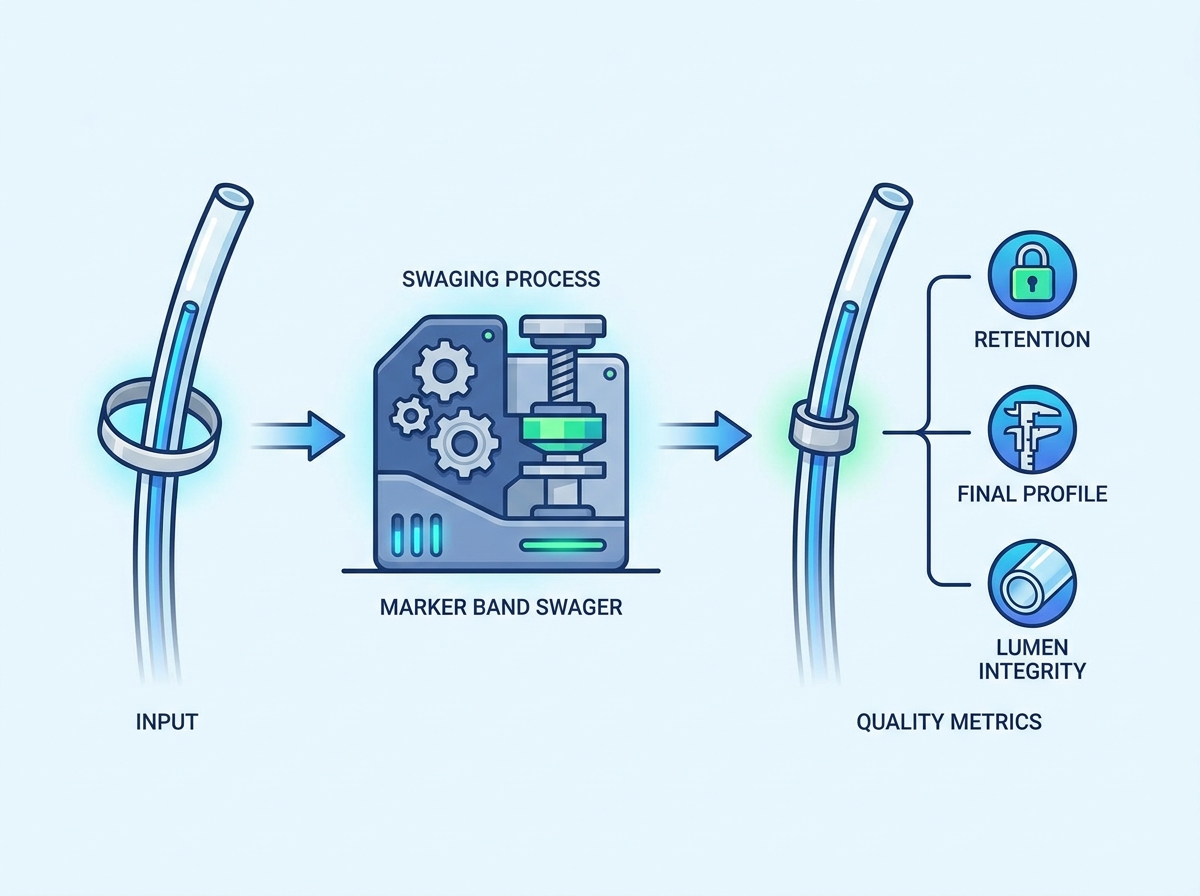
Modern catheter manufacturing equipment utilizes different mechanical approaches for band attachment. Engineers must match the machine type to their specific product requirements. The choice impacts cycle time, yield, and final device quality on the production floor.
Rotary swaging involves rapid hammering dies that rotate around the catheter axis at high speeds. Segmented radial compression applies simultaneous inward pressure using multiple die segments (typically 8 to 12) that move together to crush the band. Both methods reduce the band diameter, but their mechanics differ completely.
Feature | Rotary Swaging | Radial Compression |
|---|---|---|
Mechanical Action | High-speed rotating hammer strikes | Simultaneous inward segment closure |
Cycle Time | Very fast (often under 2 seconds) | Moderate (allows for controlled dwell time) |
Surface Finish | Can leave micro-hammer marks | Smooth, uniform surface profile |
Particulate Risk | Higher risk of metal dust generation | Low risk, cleanroom friendly |
Best Application | Large diameter, rigid shafts | Fragile micro-catheters, neurovascular devices |
Rotary swaging offers fast cycle times for high-volume, less sensitive applications. However, the surface finish can vary due to the hammering action. Radial compression provides superior precision and is ideal for delicate micro-catheters. The simultaneous closure prevents asymmetric deformation and maintains tight OD tolerances.
Cleanroom environments require strict particulate control. Rotary hammering generates microscopic metal particulates that can contaminate the catheter surface. Radial compression uses cleaner, controlled motion that minimizes contamination risks significantly. This makes radial systems the standard for ISO Class 7 cleanrooms.
Swaging is often paired with thermal reflow. Operators use FEP heat shrink tubing to encapsulate the band temporarily. Hot air or laser systems apply localized heat, causing the underlying polymer to melt and flow around the metal band. The heat shrink tubing forces the melted polymer into a smooth profile. After cooling, operators score and remove the shrink tubing.
Some advanced equipment combines mechanical swaging with thermal energy. This hybrid approach optimizes polymer flow during the compression phase, ensuring complete encapsulation of the band edges. The final profile becomes perfectly seamless, which eliminates the need for a secondary thermal processing step and reduces overall cycle time.
R&D labs often use manual or semi-automated swagers. These offer flexibility for rapid prototyping and process development. Operators load the catheter and band by hand, aligning them visually under a microscope. High-volume production requires fully automated systems where vision-guided robotics handle component placement and automated bowl feeders supply the marker bands continuously.
Automation drastically reduces operator dependency and improves yield rates by eliminating human error. Throughput scales significantly with automated feeding systems. However, automated systems require substantial upfront capital and demand complex programming and validation protocols to ensure the vision systems accurately detect band edges.
Machine specifications directly translate to catheter performance. Precise control mechanisms ensure reliable clinical outcomes. Engineers evaluate the underlying mechanics of the machine because every micron of die movement impacts the final product's retention and profile.
Programmable logic controllers (PLCs) are standard for modern machines. Servo-motor driven dies offer exact positioning, and micron-level stroke adjustments prevent over-compression. Pneumatic systems often lack this fine control due to variations in air pressure. Servo systems provide the necessary resolution for micro-catheter assembly where tolerances are measured in ten-thousandths of an inch.
Tolerance stacking is a major manufacturing concern. The band, the polymer, and the mandrel all have dimensional variations. High process capability is necessary to absorb these variations. A Cpk greater than 1.33 ensures FDA and MDR compliance, proving the process remains stable across thousands of cycles without producing out-of-specification parts.
Custom-lapped dies are mandatory for high-yield production. They must match specific band materials and dimensions perfectly. Generic dies cause uneven compression and flash. The die geometry must account for polymer spring-back. Engineers spend weeks optimizing die shapes, often using wire EDM to cut precise segment angles.
Precision swaging dies wear out over time. The friction between the die and the band degrades the surface finish. Replacement costs factor heavily into operational budgets. Predictive maintenance features track die actuation cycles and alert technicians before wear impacts product quality, preventing unexpected downtime on the line.
Equipment footprint matters in costly cleanroom environments where floor space is highly expensive. Pneumatic exhaust must be managed properly to avoid particle dispersion. ISO Class 7 or 8 compliance is standard for these machines, meaning surfaces must be easy to wipe down with isopropyl alcohol and free of particle-trapping crevices.
The swager must integrate smoothly into the manufacturing line. It connects physically and digitally with downstream stations. Thermal laminators and inspection stations follow the swaging process. Data must flow seamlessly between these machines to enable real-time quality monitoring and automated batch reporting.
Data logging capabilities are required for medical device manufacturing. The machine must record force, displacement, and temperature for every cycle. This data proves the machine operated within validated parameters. Without this data, batch release becomes impossible under modern quality management systems.
Software traceability supports 21 CFR Part 11 compliance. Digital records streamline the validation master plan and simplify regulatory audits by providing instant historical data. User access controls prevent unauthorized parameter changes, locking down the validated process state and ensuring only trained engineers can adjust the recipe.
Decision frameworks guide capital allocation strategies. Manufacturing strategy depends heavily on volume and device complexity. Companies must weigh the benefits of internal control against external expertise, a decision that impacts the entire product lifecycle and supply chain stability.
Advanced machinery requires significant capital expenditure upfront. Operating expenses include cleanroom space, specialized operator training, and continuous maintenance. Validation overhead adds continuous strain to the budget. Companies must allocate dedicated manufacturing engineering resources to maintain the equipment and troubleshoot daily production issues.
ROI timelines depend entirely on projected production volumes. High volumes justify internal equipment purchases quickly. Low volumes often favor external partnerships. Startups rarely have the capital to build full internal lines and rely on partners to bridge the gap to commercialization without burning through funding.
Complex neurovascular devices carry high manufacturing risks. They feature multi-durometer shafts, ultra-thin walls, and often require multiple marker bands spaced millimeters apart. Swaging these devices requires years of specialized experience. A single mistake ruins an expensive sub-assembly and drives up scrap rates.
Utilizing specialized catheter OEM services mitigates these risks immediately. OEMs offer pre-validated swaging processes and have established supply chains for precious metal bands. Their dedicated quality engineering teams accelerate speed-to-market and handle the complex validation paperwork internally, allowing the device sponsor to focus on clinical trials and sales.
Common pitfalls disrupt the swaging process frequently. Engineers must design these risks out of the workflow entirely. Anticipating failure modes saves months of troubleshooting later. A robust risk management file documents these potential issues and outlines the specific controls implemented on the production floor.
Thermoplastics can relax post-swaging. This material behavior leads to loose bands during shelf life. A band that passes inspection today might fail in six months, presenting a severe patient safety risk if the band dislodges in vivo.
Implementing post-swage thermal annealing helps mitigate this. The heat relieves internal stresses within the polymer. Utilizing adhesives or encapsulation acts as a secondary retention mechanism. This dual-layer approach guarantees the band remains secure even if the primary mechanical interlock degrades slightly over time.
Excess polymer can extrude between die segments during compression, creating sharp edges on the catheter surface. These edges damage blood vessels during insertion and cause the catheter to bind inside the introducer sheath.
Optimizing die segment overlap prevents this extrusion. Controlling compression speed is also vital. Slower compression allows the polymer to flow naturally rather than fracturing. Precise volume calculations for the underlying polymer ensure proper displacement. Engineers must balance band thickness with wall thickness to leave enough room for the material to move.
Inconsistent band placement causes high scrap rates. Operators struggle to position bands with sub-millimeter accuracy manually. Improper mandrel insertion damages the delicate inner lumen. Training operators takes weeks of dedicated supervision and yields inconsistent results across different shifts.
Investing in vision-assisted positioning systems removes human variability. Cameras magnify the assembly area on a screen, while hard-stop fixtures guide the operator physically. They ensure repeatable placement every single time, reducing the training burden significantly and standardizing the output regardless of the operator.
Over-reliance on destructive pull-testing is highly inefficient. It slows down batch releases significantly and destroys expensive catheters. It only provides a statistical sample of batch quality, leaving the potential for isolated defects to slip through.
Integrating in-line laser micrometers verifies the OD instantly. These sensors measure the profile as the catheter exits the machine. Vision systems confirm band placement non-destructively prior to lot sampling. This ensures 100% inspection of critical dimensions and flags out-of-tolerance parts immediately before they move to the next assembly station.
Successfully integrating marker bands requires a holistic approach. The swager, tooling, and materials act as an interconnected system. Changing one variable impacts the entire assembly. Engineers must respect this mechanical relationship to achieve reliable results on the production floor. Prioritize systems offering closed-loop feedback, micron-level die control, and robust data logging. Evaluate OEM partners based on proven IQ/OQ/PQ frameworks to save years of development time.
Baseline your current process capability by running a 30-piece sample through your existing die set and measuring OD variance.
Execute a Design of Experiments (DoE) varying compression force and dwell time to map the optimal retention window.
Audit your mandrel inventory to ensure outer diameters match the nominal inner diameter of the catheter within a 0.0005-inch tolerance.
Implement dual-axis laser micrometers on the outfeed of your swaging station for real-time profile verification.
A: Requirements vary by clinical application and regulatory body. Generally, engineers test the assembly to failure. The goal is to ensure the band does not dislodge before the catheter shaft yields. This proves the mechanical interlock exceeds the tensile strength of the substrate.
A: It requires the mandatory use of precision-ground mandrels. Operators insert these mandrels into the inner diameter during compression. The mandrel provides a rigid counter-force. This maintains lumen concentricity and prevents the polymer from collapsing inward under radial pressure.
A: The process differs significantly between materials. Soft elastomers like Pebax or Polyurethane displace easily and require specific die geometries. Rigid polymers like Polyimide resist compression. The substrate's durometer strictly dictates the swaging parameters, force requirements, and die design.
A: Swaging uses radial mechanical force to crimp the metal into the polymer. Thermal encapsulation uses heat and shrink tubing to melt the polymer over the band. This creates a seamless profile. Manufacturers often use both methods sequentially for optimal retention and smoothness.
A: Die lifespan depends heavily on the hardness of the marker band material. Platinum/Iridium wears dies much faster than Gold. Production volume also dictates wear rates. Calibration should align with standard ISO 13485 maintenance intervals, typically bi-annually or annually.
A: Outsourcing is ideal when facing constraints in cleanroom availability or internal engineering bandwidth. It is also beneficial when the complexity of the specific catheter design requires specialized, multi-process expertise that the internal team lacks.
A: Platinum/Iridium alloys and Gold are the industry standards. They offer high radiopacity under fluoroscopy. They are highly biocompatible. Their ductility makes them ideal for the mechanical swaging process, allowing them to deform predictably without fracturing.
