E-Mail: sales@microapproachmed.com
Phone: +86-17722685792
- All
- Product Name
- Product Keyword
- Product Model
- Product Summary
- Product Description
- Multi Field Search

Views: 0 Author: Site Editor Publish Time: 2026-10-12 Origin: Site


Navigating obstructed or strictured ureteral anatomy requires absolute precision. Surgeons must bypass impacted stones without causing mucosal trauma while maintaining a highly stable access tract. Historically, monolithic wire designs forced a difficult compromise in the operating room. Clinicians had to choose between the frictionless trackability of a fully hydrophilic wire and the rigidity of a standard PTFE wire. Fully hydrophilic wires lack tactile feedback and fail to support heavy device delivery. Standard PTFE wires risk insertion trauma and often fail to cross tight strictures. The structural solution to this daily clinical problem is the hybrid urology guidewire. It merges an atraumatic hydrophilic tip with a rigid, PTFE-coated shaft. This design optimizes both initial access and subsequent instrument delivery in a single device. You get the safety of a slippery tip and the pushability of a stiff shaft, eliminating the need for mid-procedure wire exchanges.
Structural Synergy: Hybrid guidewires combine a kink-resistant Nitinol core, a lubricious hydrophilic tip for atraumatic access, and a PTFE-coated shaft for tactile feedback and instrument pushability.
Procedural Efficiency: By merging the benefits of two distinct wire types, hybrid designs often eliminate the need for intraoperative wire exchanges, reducing procedure time and cost.
Risk Mitigation: The hydrophilic tip significantly reduces the risk of ureteral perforation and insertion trauma, while the PTFE shaft prevents the "slipping" commonly associated with fully hydrophilic wires during stent or sheath placement.
Procurement Value: While potentially carrying a higher unit cost than standard wires, hybrid models consolidate inventory and reduce the overall number of wires consumed per complex case.
Ureteral access defines the success or failure of most endourologic procedures. You must achieve primary access through the urinary tract safely. You must bypass impacted stones or dense strictures without creating a false passage. Finally, you must maintain a stable rail to advance ureteral access sheaths or stents. These three objectives often conflict with one another mechanically. A wire flexible enough to bypass a stone is usually too weak to support a rigid 12/14Fr access sheath.
Single-material wires suffer from inherent mechanical limitations. Standard Teflon wires provide excellent shaft support. However, they often buckle when they encounter dense strictures. Their blunt, higher-friction tips cannot navigate microscopic gaps beside impacted calculi. Conversely, fully hydrophilic wires glide past obstructions effortlessly. Yet, they fail to provide enough rigidity to advance a heavy dilator. They also tend to slip out of the urinary tract during instrument exchanges, a phenomenon often referred to as the watermelon seed effect.
This creates a biomechanical requirement for variable friction. You need extremely low friction at the leading edge for safe navigation. You need moderate friction at the trailing edge for secure handling and device tracking. Traditional urology guidewires force surgeons to use a two-wire technique. They navigate with a slippery wire, insert an exchange catheter, and swap to a stiff wire. This process wastes valuable operating room time and increases the risk of losing access entirely if the exchange catheter backs out.
Maintaining access is non-negotiable. If you lose wire access after spending thirty minutes navigating a tortuous ureter, you must start the procedure over. This increases fluoroscopy time, patient anesthesia time, and the risk of ureteral edema. The variable friction of a hybrid design directly addresses this failure point by keeping the wire anchored securely in the surgeon's hands while the tip does the delicate navigation work.
The internal core dictates how a wire behaves under stress. Nitinol is a unique nickel-titanium alloy. It possesses exceptional shape-memory and super-elastic characteristics. When you bend a stainless steel wire past a certain angle, it permanently deforms due to plastic deformation. Nitinol absorbs the stress through a phase transformation from austenite to martensite. It can bend up to 8% strain and snap back to its original straight shape. This core material forms the backbone of modern urological guidewire structure.
Kink resistance is essential in tortuous anatomy. The ureteropelvic junction often presents sharp, challenging angles. A Nitinol core prevents the wire from buckling or kinking when navigating these sharp turns. If a wire kinks, it can no longer serve as a continuous rail for instruments. The sheath or stent will hang up on the kinked segment, halting the procedure and requiring a complete wire exchange.
Furthermore, the Nitinol core ensures precise torque transmission. When you rotate the proximal end of the wire, that rotational force must reach the tip. Nitinol provides a nearly one-to-one torque response. This allows you to steer the angled tip of the wire into specific renal calyces or past asymmetrical obstructions with pinpoint accuracy. You do not have to over-rotate the wire to get a response at the distal end.
The distal tip of the hybrid wire is designed purely for safe navigation. Hydrophilic polymers coat this section. When exposed to water or saline, these polymers bind water molecules to their surface. This creates a microscopic, highly lubricious hydrogel layer. The coefficient of friction drops dramatically. The wire feels incredibly slippery to the touch, allowing it to glide over the ureteral mucosa without catching.
This coating works in tandem with floppy tip dynamics. The Nitinol core tapers down significantly at the distal end. This makes the tip highly flexible or "floppy." The combination of a floppy core and a low-friction coating allows the wire to negotiate tight spaces effortlessly. It bypasses impacted calculi without pushing them further up the ureter. Most importantly, it prevents mucosal dissection or false passages, minimizing insertion trauma.
Manufacturers carefully control the length of this hydrophilic segment. It typically spans the first 3cm to 5cm of the wire. This provides just enough length for safe, atraumatic navigation. If the hydrophilic segment were longer, it would compromise the overall rigidity of the shaft and loop uncontrollably in the bladder. The short floppy tip ensures you can bypass a stone while keeping the stiff shaft close behind for immediate dilation.
The proximal portion of the hybrid wire serves a completely different mechanical purpose. This section is coated with Polytetrafluoroethylene, commonly known as PTFE or Teflon. PTFE provides a smooth surface, but it is not slippery like a hydrated hydrophilic coating. It offers a distinct, tactile surface that you can grip securely with your fingers or wet surgical gloves.
Tactile feedback is essential during complex cases. The PTFE shaft allows you to "feel" the resistance inside the ureter. When the wire encounters a dense stricture, the PTFE transmits that resistance back to your hands. This feedback is required for assessing stricture density. It helps you avoid applying excessive force that could perforate the ureteral wall, a common complication with overly stiff monolithic wires.
Instrument tracking relies heavily on this firmer segment. The PTFE coating provides the necessary surface friction to hold the wire in place. When you advance a ureteroscope, a stent, or a large access sheath over the wire, the wire must not move. Fully hydrophilic wires often slip out during this step. The PTFE shaft grips the surrounding tissue and the working channel just enough to secure the wire, allowing you to advance heavy instruments safely.
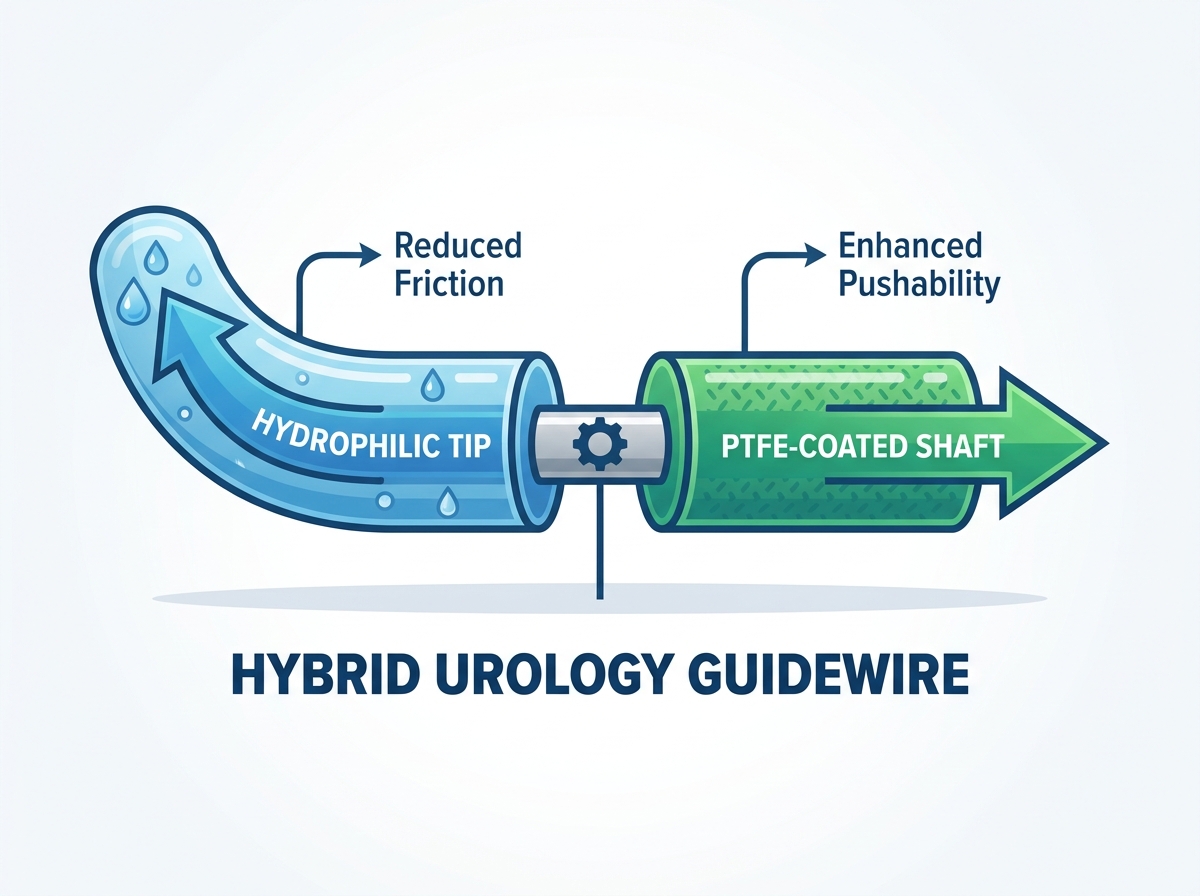
Understanding mechanical properties helps you select the right tool for the anatomy. Tip flexibility metrics reveal stark differences between wire types. We measure the bending force required to deflect the tip of the wire. A standard PTFE wire requires roughly 50 grams of force to deflect. A hybrid's floppy tip requires less than 10 grams. This massive difference illustrates the hybrid's superior safety profile. It bends away from the delicate ureteral mucosa rather than piercing it.
Shaft rigidity is equally important for device delivery. We analyze the mechanical stiffness of the hybrid's proximal shaft against fully hydrophilic alternatives. The hybrid wire utilizes a thicker Nitinol core in the proximal section. This provides superior support for heavy or rigid instruments. Fully hydrophilic wires often lack this proximal stiffness, causing them to buckle when you push a tight dilator over them.
Handling trade-offs become obvious the moment you open the package. Fully hydrophilic wires are notoriously slippery. They often require a separate torque device just to hold them securely. The hybrid wire eliminates this frustration. The PTFE shaft gives you a secure, dry grip. You can manipulate the wire easily with bare or gloved hands without needing extra accessories.
Device advancement highlights another major difference. When you push a stiff catheter over a fully hydrophilic wire, the wire can prolapse. It may back out of the kidney entirely due to the lack of friction. Hybrid wires hold their position. The PTFE shaft provides enough friction against the working channel and the patient's anatomy to stay exactly where you placed it, ensuring you do not lose access during critical moments.
Access capabilities differ wildly between these two designs. A standard PTFE wire has a blunt, higher-friction tip. When it hits an impacted stone, it often stops completely. It cannot find the microscopic gaps between the stone and the ureteral wall. The hybrid wire excels here. Its hydrophilic tip glides through those microscopic gaps, securing access past the obstruction without dislodging the stone.
Trauma risk is a constant concern in endourology. Standard PTFE wires carry a higher risk of ureteral perforation. If you push too hard against a stricture, the stiff tip can create a false passage. The hybrid wire mitigates this risk entirely. The floppy tip buckles and loops back on itself if it hits a solid wall, protecting the patient from serious insertion trauma and subsequent stricture formation.
Trackability defines how well the wire follows the anatomy and how well instruments follow the wire. The hybrid design offers the highest combined trackability score. The tip tracks through the tortuous anatomy perfectly. Then, the rigid shaft ensures that your access sheath tracks over the wire without buckling or kinking the system.
Lubricity retention matters during prolonged procedures. You must know how long the hydrophilic tip remains slippery before requiring re-hydration. High-quality hybrid wires maintain their lubricity for extended periods. However, if the procedure is lengthy, you may need to flush the tip with saline to reactivate the coating and prevent it from drying out inside the patient.
Radiopacity is non-negotiable for fluoroscopic visibility. You must see exactly where the tip is located under X-ray. Hybrid wires incorporate dense metals into the distal tip. Manufacturers use tungsten coils, platinum bands, or gold markers. This ensures the floppy tip shines brightly on the monitor, allowing for precise placement within the renal pelvis without guessing.
Feature | Hybrid Urology Guidewire | Fully Hydrophilic Guidewire | Standard PTFE Guidewire |
|---|---|---|---|
Core Material | Nitinol (Super-elastic) | Nitinol (Highly flexible) | Stainless Steel or Nitinol |
Tip Lubricity | Extremely High (Hydrophilic) | Extremely High (Hydrophilic) | Low (PTFE) |
Shaft Grip/Handling | Excellent (Tactile PTFE) | Poor (Slippery, requires torquer) | Excellent (Tactile PTFE) |
Instrument Support | High (Stiff Nitinol Core) | Low to Moderate | High (Stiff Core) |
Trauma Risk | Very Low | Very Low | Moderate to High |
Radiopacity | High (Tungsten/Platinum tip) | Moderate to High | Low to Moderate |
Ureteroscopy relies on securing reliable access past ureteral stones. You use the hybrid wire for initial navigation. The hydrophilic tip easily slides past the calculus without displacing it proximally into the kidney. Once the tip is coiled safely in the renal pelvis, the stiff shaft is positioned perfectly in the ureter.
This facilitates immediate procedural progression. You can place a ureteral access sheath directly over the same wire used for initial navigation. The transition from the floppy tip to the stiff shaft provides the exact mechanical support needed to push the sheath up to the stone. This single-wire technique streamlines stone management significantly.
Advance the hydrophilic tip past the impacted stone under direct fluoroscopic guidance.
Confirm the floppy tip is safely coiled within the renal pelvis to anchor the wire.
Hold the PTFE shaft securely at the urethral meatus to prevent forward or backward movement.
Advance the ureteral access sheath over the stiff PTFE shaft until it reaches the stone face.
PCNL requires establishing antegrade access through the renal parenchyma. You puncture the kidney and advance a wire down the ureter. Hybrid wires excel in this application. The floppy tip navigates the complex calyceal anatomy and finds the ureteropelvic junction easily. It drops down the ureter without traumatizing the delicate renal papilla.
Once down the ureter, the stiff PTFE shaft remains in the puncture tract. This highlights the importance of the hybrid design. You need that stiff shaft to guide fascial dilators and large Amplatz sheaths into the kidney. The rigid proximal section prevents the dilators from kinking the wire during tract dilation, ensuring you do not lose your percutaneous access.
Severe strictures demand careful technique. You use the hydrophilic tip to probe the stricture gently. The low-friction coating allows the tip to find the true lumen. By applying gentle torque to the PTFE shaft, you can steer the angled floppy tip through the narrowed segment without causing a false passage.
The transition zone of the wire plays a vital role here. As you advance the wire, the transition between the floppy tip and the stiff shaft enters the stricture. This gradual increase in stiffness dilates the stricture slightly. It creates just enough space to allow subsequent instrument passage, turning a difficult case into a manageable one without requiring immediate balloon dilation.
Evaluating clinical tools requires looking beyond the initial purchase price. A hybrid wire generally carries a higher upfront unit cost than a basic PTFE wire. However, it drastically reduces the total number of wires opened per case. In complex cases, surgeons routinely open a hydrophilic wire for access and a stiff wire for delivery. The hybrid eliminates this two-wire technique entirely.
You must also calculate the value of time saved in the operating room. Intraoperative wire exchanges take time. They require removing one wire, inserting a catheter, and feeding a new wire under fluoroscopy. By avoiding these exchanges, you save valuable minutes per case. In a high-volume endourology center, these saved minutes translate into significant daily efficiency, allowing for faster room turnovers.
Proper preparation protocols ensure the wire functions as intended. The hydrophilic tip remains inactive while dry. You have a strict requirement to flush or hydrate the tip with sterile saline or water prior to use. Most packaging includes a flush port. Injecting saline into the hoop activates the polymer coating instantly, preparing it for insertion.
Handling risks exist if protocols are ignored. You must warn surgical staff against wiping the hydrophilic tip with dry gauze. Dry gauze acts like sandpaper on the delicate polymer. It can strip the coating entirely. This destroys the lubricity and can leave microscopic polymer debris inside the patient's urinary tract. Always handle the tip with wet gloves and wet gauze.
Inventory consolidation simplifies supply chains and reduces storage clutter. Many hospitals find it highly feasible to standardize on hybrid guidewires. Making them the default choice for all endourology cases streamlines case carts. Nurses do not have to guess which wire the surgeon might need. The hybrid covers the vast majority of clinical scenarios effectively.
However, you must identify clinical edge cases. Specialized wires are still clinically mandatory in certain situations. For example, massive percutaneous tract dilation may still require an ultra-stiff Amplatz wire. Navigating completely obliterated ureters might require a fully hydrophilic Glidewire. Keep a small stock of these specialized tools while using the hybrid as your daily driver.
Audit your current wire usage to identify how often surgeons open multiple wires during a single ureteroscopy case.
Conduct an OR trial with hybrid samples to let high-volume surgeons assess tactile feedback and trackability during complex stricture cases.
Update preparation protocols to train nursing staff on strict hydration requirements and the dangers of wiping hydrophilic tips with dry gauze.
Standardize the case cart by replacing standard PTFE and fully hydrophilic wires with hybrid models for routine stone cases.
A: It is a specialized medical device used to gain access to the urinary tract. It combines a lubricious hydrophilic-coated tip for safe navigation and a rigid PTFE-coated shaft for secure handling. Both coatings are applied over a kink-resistant Nitinol core, offering the benefits of two different wire types in one tool.
A: A hydrophilic tip drastically reduces surface friction when activated by saline. This allows the wire to navigate tight strictures atraumatically. It minimizes insertion trauma, prevents mucosal damage, and easily bypasses impacted kidney stones without pushing them further up the ureter.
A: The PTFE coating provides a dry, tactile surface that surgeons can grip securely. Unlike slippery hydrophilic shafts, the PTFE section stays in place. It provides a highly stable rail for advancing heavy ureteral access sheaths or stents without the wire slipping out of the tract.
A: Nitinol is a super-elastic alloy with shape memory. It provides excellent kink resistance, ensuring the wire does not buckle in tortuous anatomy. It also delivers a one-to-one torque response, allowing the surgeon to steer the tip precisely by rotating the proximal end of the wire.
A: While a hybrid wire covers the vast majority of routine and complex endourology cases, it cannot replace everything. Ultra-stiff wires are still needed for massive percutaneous dilations, and fully hydrophilic wires may be required for completely obliterated strictures. It serves as an excellent default wire.
A: You must flush or soak the distal tip in sterile saline or water immediately prior to insertion. Most packaging includes a flush port for this purpose. Never wipe the tip with dry gauze, as this will strip the delicate polymer coating and ruin its lubricity.
