E-Mail: sales@microapproachmed.com
Phone: +86-17722685792
- All
- Product Name
- Product Keyword
- Product Model
- Product Summary
- Product Description
- Multi Field Search

Views: 0 Author: Site Editor Publish Time: 2026-11-05 Origin: Site


In modern interventional suites, excessive catheter exchanges prolong procedure times significantly. They also increase fluoroscopy exposure and inflate per-case clinical expenses. Selecting a single device capable of navigating diverse arch anatomies while maintaining stable contrast delivery is no simple task. It requires evaluating strict biomechanical parameters before a procedure even begins. Relying on default inventory without analyzing specific tip shapes often leads to sub-optimal vessel engagement. You might also experience dangerous catheter recoil during critical injections. This article provides cath lab directors, procurement teams, and clinicians with a rigid, evidence-based framework. We will explore how to properly evaluate a multipurpose angiographic catheter tip design. You will learn to assess curve geometry, side-hole hemodynamics, and material specifications. Ultimately, these insights will help you streamline inventory and improve patient safety across diverse clinical scenarios.
Curve Selection: Distinguishing between MPA1 and MPA2 configurations dictates the balance between distal reach and torque response in tortuous anatomies.
Hemodynamic Stability: The inclusion of side holes is a structural trade-off—it drastically increases safe contrast injection rates and mitigates catheter "whip," but requires stricter flushing protocols.
Specification Alignment: Successful procurement relies on matching French sizes (Fr), inner lumen diameters, and pressure ratings (PSI) with the lab’s standardized guidewires (e.g., 0.035") and power injector limits.
Inventory Consolidation: Standardizing on a versatile multipurpose catheter can reduce selective catheter inventory overhead, provided the baseline specs meet 80% of routine diagnostic requirements.
You need procedural efficiency in the cath lab above almost all else. Selecting the right catheter tip configuration directly impacts clinical success. It also heavily influences your department's bottom line. Opening multiple selective catheters per case drains resources quickly. A versatile multipurpose shape solves this specific problem. It allows operators to perform diverse diagnostic steps using one primary tool. This minimizes device swapping and reduces vessel trauma.
A reliable multipurpose device must pass several clinical tests before approval. First, it must cross tight aortic valves cleanly. It should engage multiple branch vessels without losing structural integrity. Second, it needs consistent torque transmission. When you rotate the hub, the distal tip must respond predictably. Lag in torque response causes severe navigational delays. Third, excellent radiopacity is completely non-negotiable. You need precise visualization under fluoroscopy to position the device safely inside the body.
We must acknowledge a hard truth regarding clinical supplies. No single diagnostic catheter is universally perfect for every patient. Your primary goal involves identifying a baseline design. This design should safely cover the highest percentage of routine scenarios. Peripheral and coronary diagnostic cases vary wildly in complexity. Finding a reliable middle ground requires balancing physical properties carefully. You must evaluate the shaft build against typical anatomical challenges faced daily.
Every millimeter of a curve changes how a diagnostic device behaves. Understanding primary and secondary radii is absolutely essential. These radii determine the resting shape of the device. They also dictate how the tip interacts against delicate vessel walls. A slight variation in angle dictates whether you successfully cannulate a vessel or prolapse out of it.
A multipurpose curve relies on a specific resting angle. When you advance it over a stiff guidewire, it straightens completely. Once you remove the wire, the tip regains its polymer memory. This memory allows the operator to steer it into target ostia smoothly. The primary curve handles the immediate engagement angle. The secondary curve provides back-wall support against the opposing aorta.
The MPA1 features a shorter, more acutely angled distal segment. It performs exceptionally well in standard aortic arches. You will find it ideal for narrower anatomies. It engages relatively straightforward ostia very quickly. The shorter tip prevents unwanted prolapse during complex manipulation. Operators prefer the MPA1 for routine diagnostic work where reach is not the primary limiting factor.
The MPA2 offers a distinctly longer distal reach. Its primary curve feels much more relaxed compared to the MPA1. We recommend it highly for dilated anatomies and elongated arches. Deep vessel seating often requires this extended reach. An MPA1 might easily slip out of these challenging anatomical spaces. The MPA2 anchors much more securely in wider aortic roots, ensuring stable contrast delivery.
Manufacturer-specific tolerances vary widely in curve retention. Standard polyurethane begins to lose its rigidity at typical body temperatures. This thermal softening can cause a primary curve to open up unexpectedly. We refer to this clinically as a loss of curve retention. You must assess how well a catheter maintains its shape after twenty minutes inside the body.
Clinical Comparison Table of MPA Configurations
Configuration Label | Distal Segment Length | Curve Angle | Ideal Anatomical Application | Prolapse Risk Profile |
|---|---|---|---|---|
MPA1 | Shorter | Acute / Tight | Standard or narrow aortic arches | Low in normal anatomy, High in dilated roots |
MPA2 | Longer | Relaxed / Open | Dilated anatomies, elongated arches | Low in deep seating, High in tight spaces |
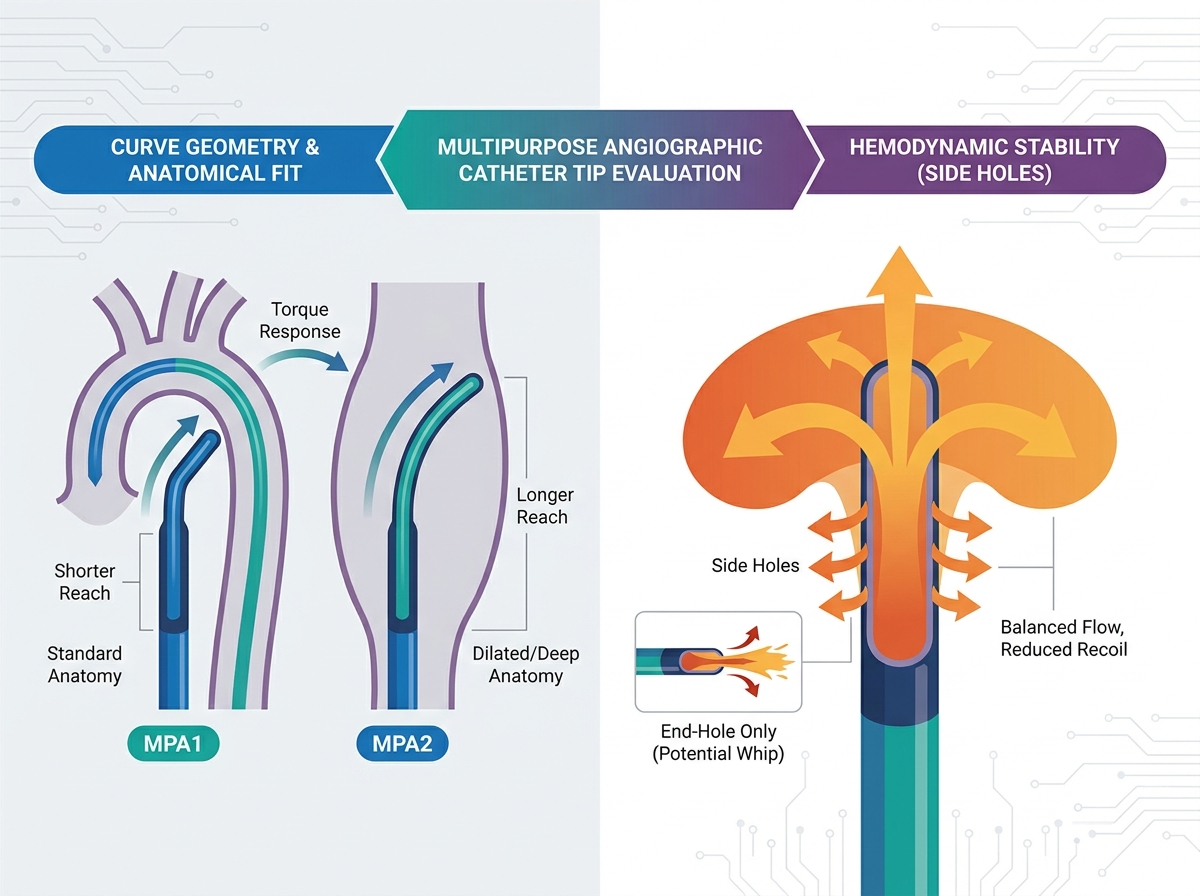
The precise physics of contrast delivery dictate overall procedural safety. Flow dynamics change drastically depending on tip hole placements. Understanding pressure management helps prevent catastrophic vessel injury during power injections.
Side holes distribute contrast media pressure efficiently across multiple exit points. They allow for high-flow power injections like left ventriculography. Without side holes, all fluid pressure forces entirely through a single end-hole. This concentrated force can easily exceed the device's designated PSI threshold. Side holes act as pressure vents, lowering the resistance safely.
Lateral contrast dispersion stabilizes the tip inside the active vessel. Think of side holes as microscopic lateral thrusters on a spacecraft. They prevent the MPA catheter from backing out of the vessel ostium. Rapid power injections create substantial backward physical force. Side holes neutralize this physical reaction beautifully, locking the tip in place.
This design choice does carry specific and notable clinical limitations. You face an increased risk of microscopic thrombus formation. Blood can pool inside the lateral holes during long cases. Operators must implement rigorous heparinized saline flushing protocols immediately. Double-flush techniques become entirely mandatory. You also risk unwanted contrast staining. If side holes sit outside the target vessel, contrast spills into non-target areas, obscuring the fluoroscopic image.
Choosing between configurations requires a clear procedural intent. Here are the common best practices:
End-Hole Only: Use these for precise sub-selective embolization. Targeted low-flow delivery requires a single, predictable exit point.
Side-Hole Configurations: Use these for high-volume diagnostic aortograms. Heavy contrast loads demand lateral pressure venting to maintain safety and stability.
Procurement requires looking far beyond basic marketing labels. Dimensional tolerances determine whether a device fits your clinical setup. We must scrutinize outer and inner diameters closely to ensure compatibility.
You must rigorously validate the Outer Diameter (Fr). It has to match your existing vascular sheath compatibility perfectly. A 5Fr device must slide seamlessly through a 5Fr introducer sheath. You must also measure the Inner Diameter carefully. It handles specific contrast viscosities and dictates wire compatibility. Most interventional labs standardize around 0.035” or 0.038” guidewires. A mismatched inner lumen causes dangerous friction.
A high-quality multipurpose catheter requires rigorous inspection across several mechanical criteria:
Shaft Construction: Checking the braiding materials and pitch.
Coating Formulation: Verifying hydrophilic properties and application length.
Pressure Ratings: Confirming automated injector safety margins.
We evaluate wire-braided polyurethane matrices for very specific reasons. They provide superior kink resistance around tight corners. They also deliver reliable 1:1 torqueability from hub to tip. Non-braided designs often twist and fail in tortuous peripheral vessels. Manufacturers use fine stainless steel or nitinol ribbons. They weave these ribbons into a tight cross-hatch pattern. A higher cross-count increases torque control while stiffening the overall shaft.
Coatings change how the device interacts inside the human body. Selective non-hydrophilic coatings offer moderate lubricity for routine cases. Fully hydrophilic bodies become incredibly slick when exposed to blood. You must carefully assess the clinical trade-off here. Extreme lubricity improves trackability immensely through calcified lesions. However, it significantly reduces tactile feedback. A slippery device might easily lose stability once positioned in a shallow ostium.
Catastrophic device failure happens rapidly during high-pressure injections. You must verify the designated maximum burst pressure. It must align seamlessly with your automated contrast injector protocols. A 1200 PSI rating offers excellent safety margins for ventriculography. Never pair a low-PSI tube with a high-pressure injector sequence. Ruptured shafts cause severe vascular trauma and require emergency surgical intervention.
Standardizing an entire cath lab inventory carries inherent risks. You must balance clinical preference against supply chain simplicity. Over-consolidating creates unexpected procedural hurdles for your physicians.
An angiographic catheter labeled "multipurpose" sounds universally adaptable. However, forcing its use everywhere increases procedural risk unnecessarily. Highly complex anatomies demand highly specific shapes. Type III aortic arches often require dedicated selective tools like Judkins or Cobra designs. Removing all selective shapes from your shelves to save space is a critical management mistake.
New device evaluations must always include extensive trial periods. You need to monitor tactile feel in real clinical cases. Paper specifications do not always translate to actual clinician handling preferences. Physicians rely heavily on how a device feels in their hands. You must gather structured, objective feedback during these trial phases to avoid poor adoption rates.
Vendor selection demands strict regulatory oversight and paperwork review. Ensure your selected partners provide clear Unique Device Identification (UDI) labeling. You need highly reliable shelf-life data for every single lot. Demand consistent sterilization validations before signing contracts. Ethylene Oxide (EtO) remains an industry standard, but you must personally verify the compliance certificates.
Evaluating multipurpose designs fundamentally involves clinical risk management. You must prioritize workflow optimization alongside unwavering patient safety. Successful procurement balances several competing mechanical priorities simultaneously. You must align flow-rate requirements based entirely on side-hole presence. You have to match anatomical reach using precise curve labels like MPA1 and MPA2. Structural reliability relies entirely on proper braiding matrices and accurate dimensional specifications.
We strongly urge inventory managers to audit current usage immediately. Review any documented side-hole related complications occurring in your facility. Challenge your existing vendors on their actual burst PSI ratings. Ask them for concrete curve retention data at human body temperature. Taking these proactive steps ensures your interventional lab operates at peak clinical efficiency.
A: The MPA1 has a shorter distal length and a tighter primary curve radius, making it suitable for standard or narrow aortic arches. The MPA2 features a longer distal reach and a relaxed curve, making it ideal for navigating dilated anatomies or deep vessel seating.
A: No. Side holes are specified primarily for high-pressure, high-volume contrast injections to prevent catheter recoil. End-hole-only designs are used for highly targeted, low-flow selective embolization work.
A: The inner lumen dictates the maximum contrast flow rates safely achievable. It also determines which guidewires (typically 0.035" or 0.038") can pass through without causing mechanical friction or stripping the wire's coating.
A: No. While multipurpose designs handle a vast majority of routine anatomies, complex tortuosity or highly specific branch engagements still necessitate dedicated selective shapes like Judkins or Cobra configurations.
