E-Mail: sales@microapproachmed.com
Phone: +86-17722685792
- All
- Product Name
- Product Keyword
- Product Model
- Product Summary
- Product Description
- Multi Field Search

Views: 0 Author: Site Editor Publish Time: 2026-11-20 Origin: Site


Evaluating medical devices requires absolute precision. Clinical evaluation committees face a daunting primary challenge every day. They must translate manufacturer bench data into predictable in vivo performance. This task proves incredibly difficult inside tortuous neurovasculature. The stakes are exceptionally high for patient safety. Misjudging specifications like neuro microguidewire tip load carries serious risks. Ignoring core material transitions can easily lead to vessel perforation. It also causes poor device tracking or prolonged procedure times. We must navigate these clinical risks effectively. This article provides an objective, evidence-oriented framework. It will help you evaluate and shortlist devices accurately. You will learn to base procurement decisions on rigorous interpretation of bench performance specifications. We will explore tip load nuances, visibility trade-offs, and torque dynamics.
Tip Load is Not Absolute: A microguidewire tip load specification indicates buckling force on a bench, but clinical tactile feedback is heavily influenced by transition zones and core wire materials.
Radiopacity Trade-offs: Selecting the ideal guidewire radiopacity requires balancing distal tip visibility with the risk of blooming artifacts that obscure microcatheter markers.
Torque is System-Dependent: Guidewire torque transmission relies on the synergy between the core taper design and the hydrophilic coating's durability under friction.
Bench vs. Clinical Reality: Procurement decisions must account for the limitations of standardized bench testing (e.g., glass models) when predicting performance in complex, patient-specific anatomy.
We must first understand the baseline measurements. Manufacturers define microguidewire tip load clearly. They measure the gram-force required to buckle the distal tip against a flat surface. This bench metric offers a simple baseline. However, clinical application demands much deeper analysis. The flat surface test ignores complex vascular curvature.
We frequently navigate a safety versus tactile feedback paradigm. Low tip load designs measure below 1.0g. They prioritize safety in fragile vessels. They excel during delicate aneurysm coiling procedures. Unfortunately, they sacrifice operator tactile feedback. Higher tip load designs exceed 1.5g. They enhance tactile response significantly. They improve crossing capability for complex lesions. Yet, they increase the risk of dissection or perforation.
Internal architecture dictates the actual operator feel. Core-to-tip designs transmit force directly from the shaft. They feel "snappy" and highly responsive. Shaping ribbon designs separate the core from the distal tip. They feel "mushy" or softer during navigation. This subjective feel happens regardless of the stated gram-force.
You must evaluate tip load specs systematically. Follow this process to align specifications to clinical needs:
Identify the primary clinical application for the device.
Determine the maximum safe buckling force for the target anatomy.
Assess the required tactile feedback level for the operator.
Access wires need different profiles than therapeutic delivery wires. Always match the buckling force to the specific anatomical challenge.
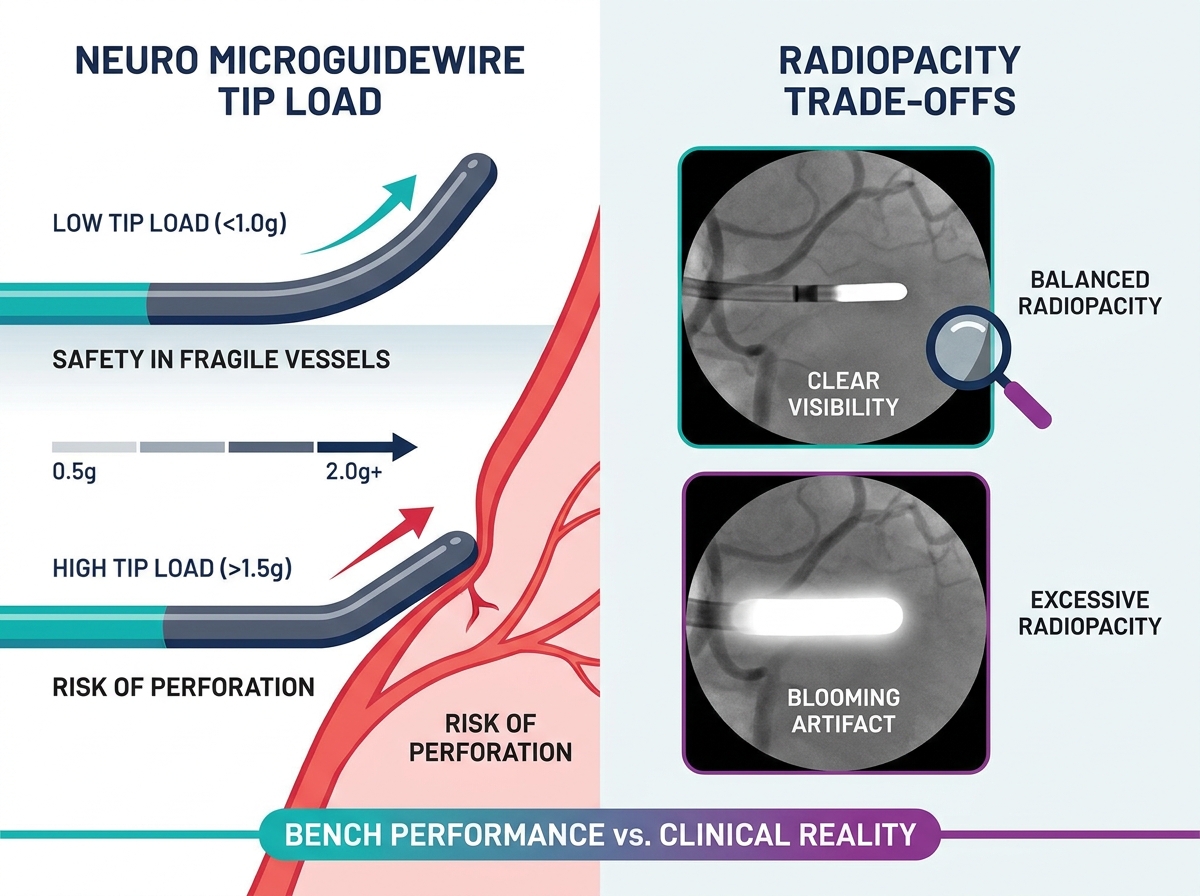
Visibility under fluoroscopy remains non-negotiable. Material science drives this essential visibility. Manufacturers typically use platinum, tungsten, or gold alloys. Platinum offers excellent fluoroscopic density. Tungsten provides a stiffer, highly visible alternative. Gold alloys maximize radiopacity but increase manufacturing complexity.
Coil length specifications vary significantly across product lines. Short radiopaque distal coils measure around 3cm. They pinpoint the exact tip location precisely. Extended coils measure 10cm or more. Extended radiopacity aids in complex vascular navigation. You can visualize a much larger segment of the wire. However, extended coils alter the wire's flexibility profile. They can make the distal segment noticeably stiffer.
We must manage "blooming" artifacts carefully. Excessive guidewire radiopacity creates a visual halo effect on monitors. This glare obscures critical anatomical landmarks. It hides microcatheter marker bands entirely. It might even mask delicate deployed stents. You lose procedural confidence when visual interference occurs.
Use a strict evaluation lens for imaging compatibility. Match radiopacity specifications to your imaging equipment capabilities. Consider your specific procedural requirements carefully. Flow diverter deployment requires precise visualization without any blooming. Balance necessary visibility against visual interference risks.
Steering through tortuous anatomy requires absolute precision. We define guidewire torque transmission as the proximal-to-distal rotational accuracy. A 1:1 response ratio is critical for operators. You need this accuracy to steer safely through the carotid siphon. It is equally vital in the middle cerebral artery (MCA).
Core materials dictate this mechanical response entirely. Nitinol offers superior kink resistance. It maintains excellent shape retention in tortuous anatomy. Stainless steel provides enhanced pushability. It delivers robust proximal support. Manufacturers often create hybrid cores. They blend these materials to optimize torque. This hybrid approach maintains necessary distal flexibility.
Material Comparison Chart
Core Material | Primary Advantage | Clinical Implication |
|---|---|---|
Nitinol | Kink Resistance | Maintains shape in tortuous vessels. |
Stainless Steel | Pushability | Provides strong proximal support. |
Hybrid | Balanced Torque | Optimizes steering and flexibility. |
Hydrophilic coatings play a massive role in navigation. Coating durability directly impacts torque over time. A coating might degrade during a prolonged clinical case. This degradation drastically reduces overall torque transmission. Increased friction absorbs the rotational force quickly. The wire becomes unresponsive.
Ask vendors specific questions about torque testing methodologies. Do they test in straight models? Do they use tortuous anatomical models? Straight models do not reflect clinical reality. Demand performance data from complex, tortuous testing environments.
We cannot trust bench data blindly. Standardized testing has severe limitations in medical device evaluation. ISO and ASTM standard bench tests use rigid glass models. They rely on silicone models at room temperature. These static models ignore dynamic, pulsatile human vasculature. Blood flow alters device behavior completely.
Marketing materials often feature bold comparative claims. You will see phrases like "superior trackability" or "enhanced flexibility." Read these claims objectively. They compare specific variables under highly controlled conditions. They do not guarantee clinical superiority in human patients.
Look for data sheets displaying transparent assumptions. Vendors must clearly state their testing conditions. They should list the exact bend radius used. They must disclose the fluid temperature and catheter compatibility details.
Clinical engineering and procurement teams need robust validation strategies. You cannot rely solely on glossy brochures. Validate bench data through controlled clinical evaluations. Seek out independent peer-reviewed literature. This evidence-based approach bridges the gap between the lab and the Cath lab.
Structured evaluation is mandatory for procurement success. You should build a comprehensive evaluation matrix. This matrix separates primary specifications from secondary features.
Neuro Microguidewire Evaluation Matrix
Category | Specifications to Evaluate | Clinical Rationale |
|---|---|---|
Primary Specs | Tip load, Outer Diameter (OD), length, radiopaque coil length. | Directly impacts vessel safety and lesion crossing capability. |
Secondary Specs | Core material, coating type, tip shape retention. | Influences device longevity and torque transmission during use. |
We face a constant tension in hospital procurement. Businesses want portfolio consolidation to reduce SKU counts. Clinicians need highly specialized wires for distinct pathologies. You need ultra-soft wires for treating delicate aneurysms. You need supportive wires for executing stroke thrombectomy. Balance these competing priorities carefully.
Verify compliance and supply chain risks rigorously. Ensure MDR and FDA compliance documentation exists. Check the sterilization shelf-life limits. Evaluate the manufacturer's supply chain resilience. Stockouts during critical neurovascular procedures are unacceptable.
Structure clear next-step actions for your committee. Initiate a limited market release (LMR) program. Run a formal clinical trial phase within the hospital. Validate the shortlisted neuro microguidewire models against established success criteria. Use real-world feedback to finalize long-term procurement decisions. Select the right neuro microguidewire partner based on proven clinical results.
Reading bench performance specifications requires looking far beyond isolated numbers. A successful device evaluation aligns several critical factors perfectly. You must harmonize tip buckling force, visibility metrics, and rotational accuracy. Align these factors directly to your specific clinical workflows. Prioritize patient safety requirements above all else.
Procurement and clinical teams hold significant power. Demand transparent, tortuous-model testing methodologies from vendors. Do this before initiating any internal clinical trials. Establish firm success criteria before bringing any new device into the neuro suite. Evidence-based procurement protects patients and improves clinical outcomes.
A: There is no single standard tip load. It ranges widely based on the clinical goal. Wires for highly fragile anatomy often use less than 0.5g. Crossing applications require more support, often exceeding 2.0g. You must select the load based on the specific anatomical challenge.
A: Highly radiopaque wires can visually merge with catheter markers under fluoroscopy. This blooming effect obscures critical navigation points. You must carefully select contrasting materials or optimal coil lengths. Proper selection ensures both the wire tip and catheter markers remain distinctly visible during the procedure.
A: Several factors cause torque degradation. Hydrophilic coatings break down under continuous friction. Blood coagulation adds resistance along the wire shaft. Furthermore, navigating complex anatomical curves absorbs rotational force. These elements combined prevent the proximal rotational input from reaching the distal tip accurately.
A: Bench testing provides a useful baseline for comparison. However, it cannot accurately predict in vivo performance. Rigid bench models fail to replicate patient-specific tortuosity. They ignore dynamic friction and pulsatile hemodynamic forces. Clinical trials remain essential to validate actual device performance in human vasculature.
